Acoustic booths management: boosting productivity and employee experience in open offices



In a hybrid work environment where employees move between workspaces depending on daily tasks, acoustic booths have become strategic assets within offices. More cost-effective and flexible than traditional meeting rooms, they provide areas for privacy and focus, which are highly valued by employees.
However, managing these booths remains a challenge for workplace managers, who must ensure optimal usage without causing frustration or wasted time. Achieving this requires three key pillars: real-time visibility, configuration adapted to each type of space, and continuous usage data analysis.
.
Understanding needs: different types of acoustic booths
Acoustic booths are not all intended for the same tasks. Identifying their function and equipping them according to their type is essential for smooth management.
- Small acoustic pods or phone booths for 1–2 people: These provide true privacy. Compact and easy to integrate into open spaces or located in corridors, they are ideal for quick calls, one-to-one meetings, or occasional focus time. Their spontaneous use and high turnover require automated management to optimize employee flow.
The presence sensor, such as the ROOMZ Huddle Sensor, is particularly suitable here: it detects occupancy without user action and automatically releases the space 15 minutes after departure. The status (red/green) is updated automatically on an interactive floor plan, accessible via a smart TV or the myROOMZ web and mobile app, ensuring always up-to-date information easily accessible to all teams.
.
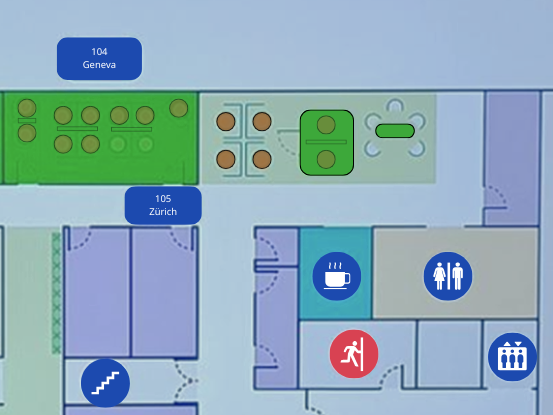 Example: a two-person booth on the right showing “available” status on myROOMZ
.
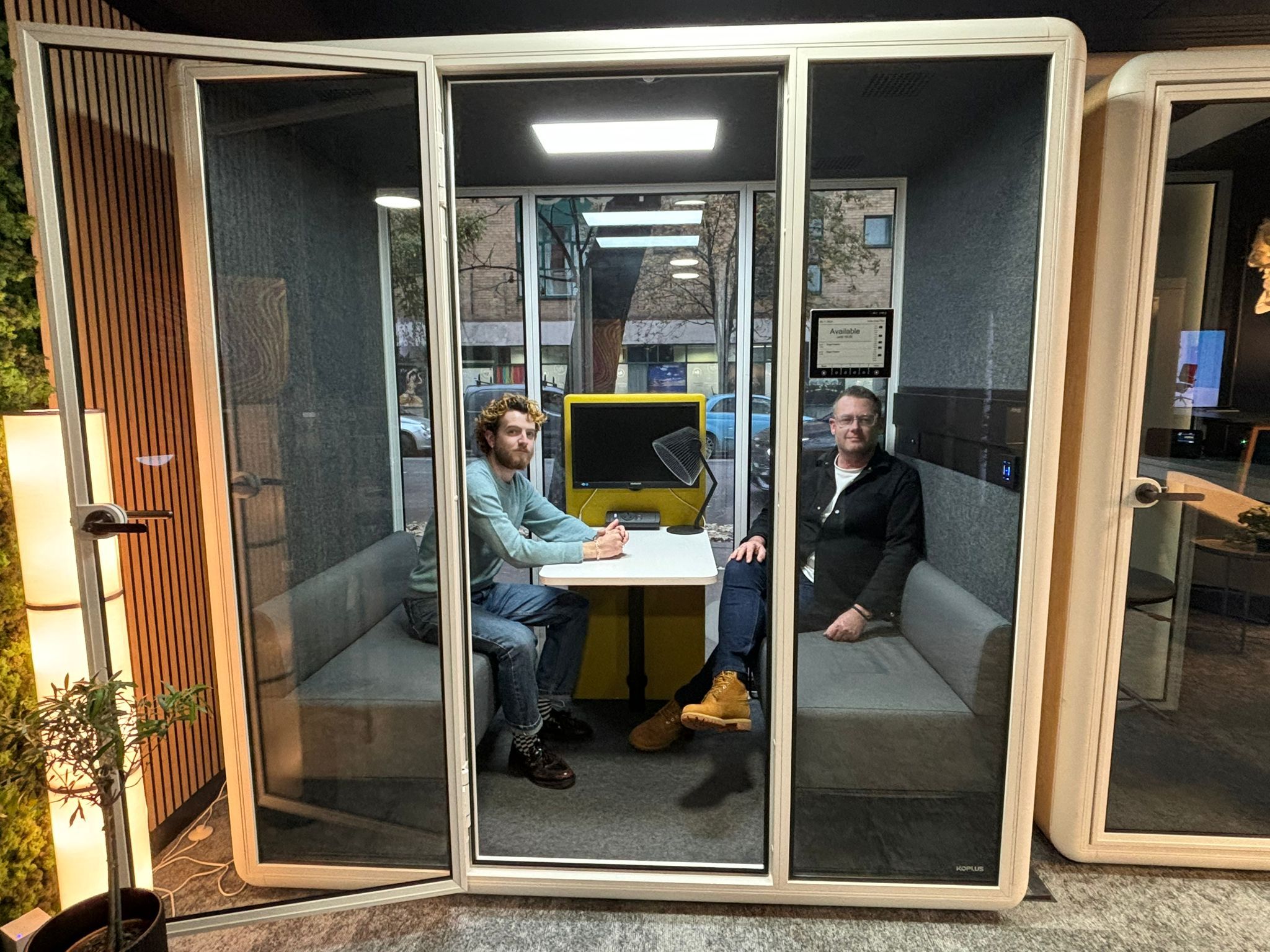
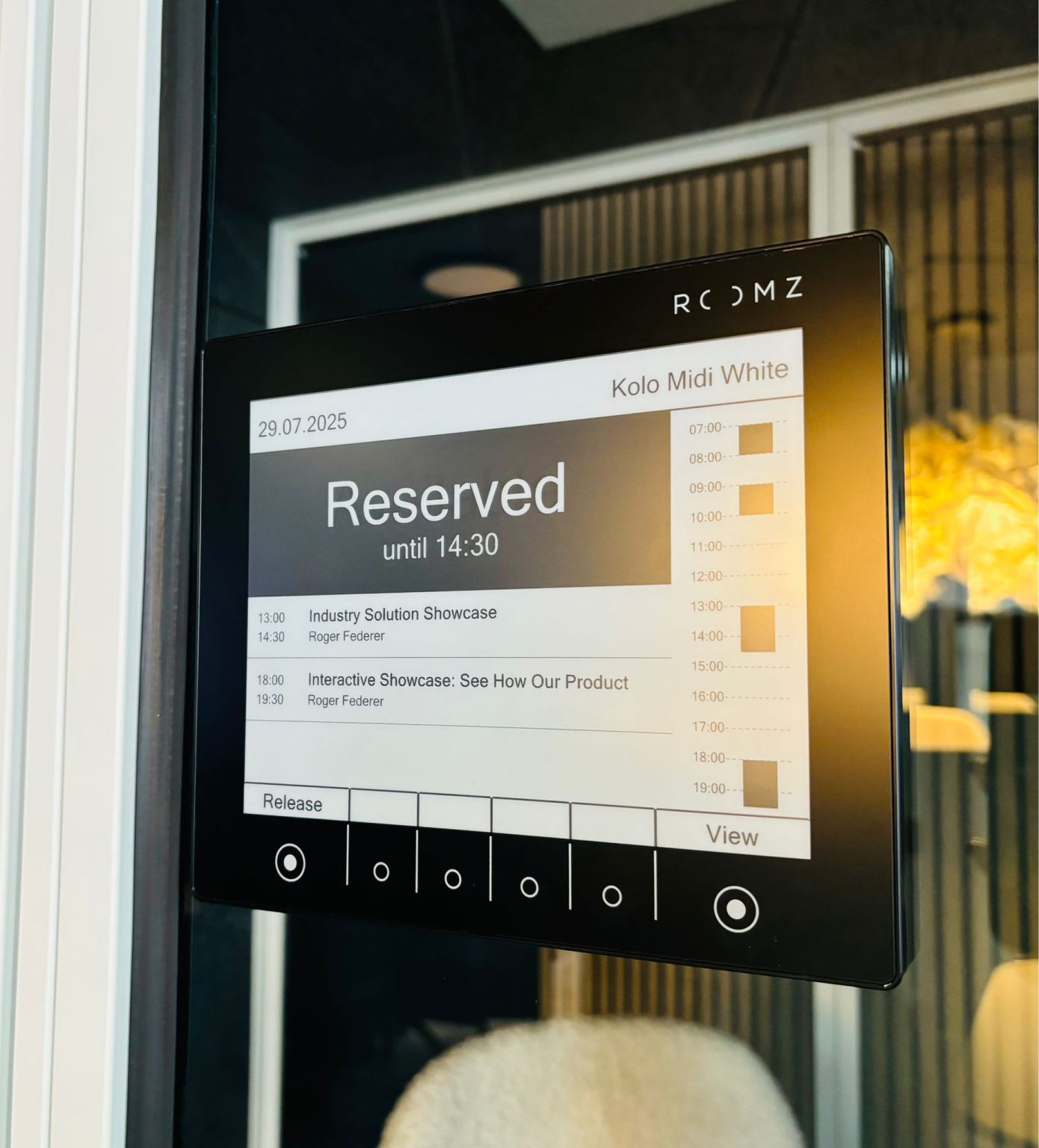
- Medium-sized acoustic pods for 4–6 people: These are more like compact meeting rooms, used for relatively short collaborative sessions. In this context, adding a booking screen becomes relevant. It allows advanced or hot bookings, and provides a level of control suited to more formal use.
The wireless design of ROOMZ booking displays is particularly valuable here: easily installed in minutes and suitable for glass surfaces, they enable straightforward and flexible setup for collaborative spaces.
.
.
Analyzing and optimizing booths usage with data
Beyond real-time management, workplace managers need to understand precisely how collaborative booths are used and whether their number truly meets team needs. ROOMZ Advanced Analytics, combined with occupancy sensors, provides reliable data to identify overused, underutilized, or poorly distributed spaces, offering a clear view of the efficiency of these micro-spaces.
These insights are particularly useful to:
- Adjust the number of booths per floor or zone
- Prevent overcrowded areas
- Define the optimal ratio between collaborative spaces and individual workstations
- Provide a variety of spaces suited to actual team usage
For example, if analysis indicates that two acoustic booths on the third floor operate at 90% capacity, it may justify adding a third. Conversely, rarely used spaces can be reconfigured or moved to higher-demand areas. This data-driven approach replaces subjective impressions with informed decisions, optimizing real estate investment.
.
Customer testimony: lastminute.com optimizes 27 phone booths across 10 floors
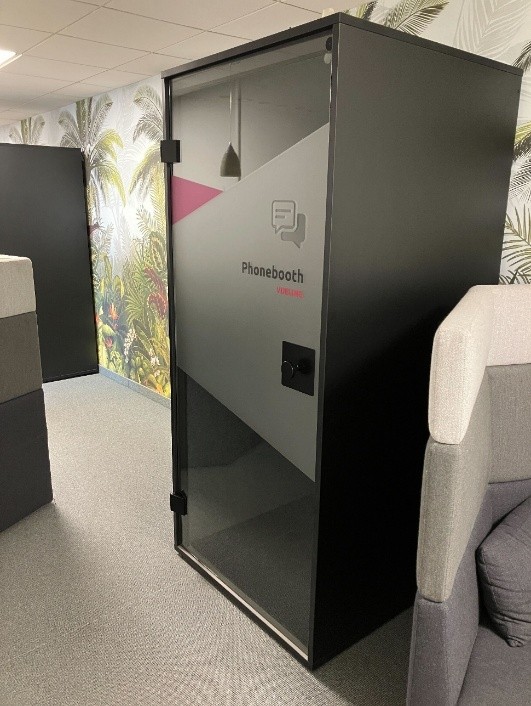
The headquarters of lastminute.com in Chiasso, Switzerland, perfectly illustrates these benefits. Before adopting myROOMZ, the challenge was significant: enabling 450 employees to quickly find an available phone booth across two buildings with multiple floors, without wandering the corridors unnecessarily.
Stefano Poli, End User Service Team Leader, explains:
“These small spaces, used for short calls and confidential exchanges, are important, yet their occupancy status changes constantly. While we encourage our people to keep their step count up, traipsing around from floor to floor trying to find somewhere private was a waste of people’s time.”
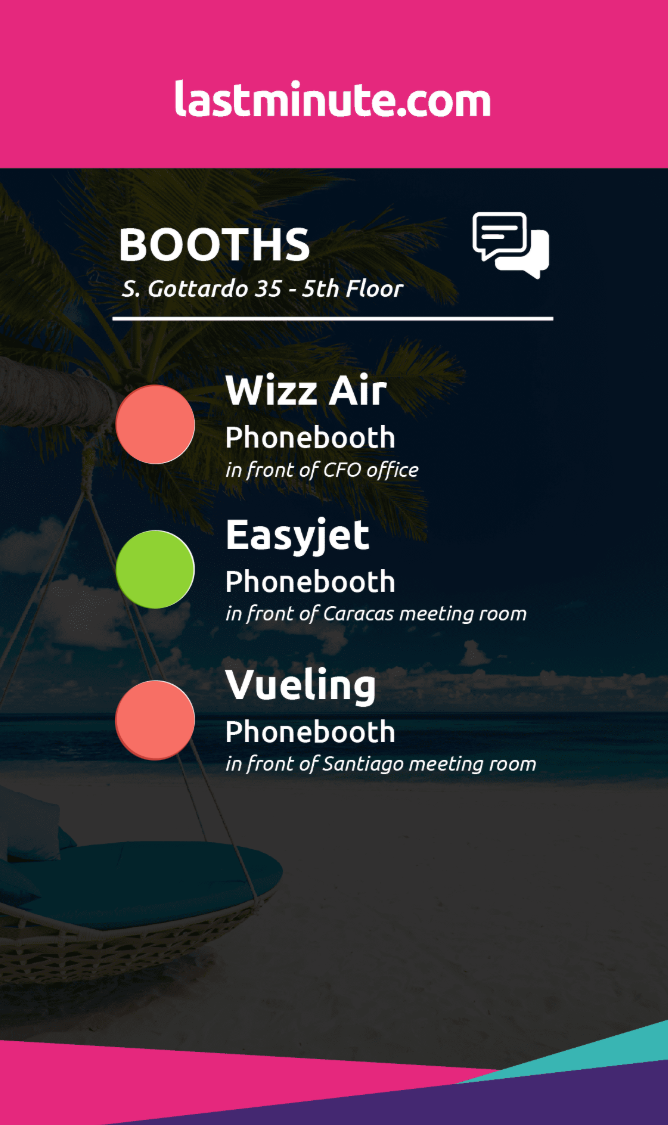
To address this, Stefano Poli implemented the myROOMZ app with an innovative configuration: instead of a traditional floor plan, a list view displays all phone booths, their real-time status, location, and contextual markers, allowing everyone to quickly find an available space.
.
👉 Discover the full story here >
.
Effective management of acoustic booths relies on balancing automation, visibility, and analysis. By adapting the solution to the type of space—sensors for individual booths, booking displays for larger spaces—and leveraging usage analytics, Facility Managers gain operational efficiency while employees enjoy a smooth and intuitive experience. The lastminute.com example demonstrates that thoughtful configuration transforms the use of these micro-spaces, which are now essential for productivity in modern offices.
You might also like:
• How workplace diversity drives employee satisfaction (Blog)
• myROOMZ mobile and PC application
.
👉 FAQ on acoustic booths in the workplace
What is an acoustic booth?
An acoustic booth is a closed or semi-enclosed space designed to provide privacy and concentration in open offices. It is suitable for phone calls, small meetings, or short periods of individual work.
Why install acoustic booths in open offices?
They enhance productivity and employee experience by offering private areas, reducing noise distractions, and helping manage office space efficiently without expanding traditional meeting rooms.
What is the difference between a small booth and a 4–6 person booth?
Small booths are ideal for 1–2 people for quick calls or individual work, while medium-sized booths act like compact meeting rooms for short collaborative sessions and can be booked in advance.
How can acoustic booth usage be optimized?
ROOMZ presence sensors and booking displays simplify acoustic booth management, minimize scheduling conflicts, and boost operational efficiency for Facility Managers.

