Digital room sign: the complete guide for offices, education, and public administration



| Printed schedules, paper signs in plastic holders, handwritten “Occupied” notes, many buildings still rely on paper signs that become outdated almost immediately. Room booking displays replace these temporary solutions with digital signage that updates automatically from your calendar or meeting room booking system. As employees continue to return to the office, making better use of available space has become a growing priority. According to the latest CBRE Global Workplace & Occupancy Insights, report, the average office occupancy rate worldwide increased from 38% in 2024 to 53%. As a result, real-time room availability and automated booking workflows are becoming the standard across businesses, educational institutions, and public sector organizations. |
What is a meeting room digital room sign?
Digital signage for meeting rooms are digital door signs installed outside meeting rooms. They display real-time information such as the room name, occupancy status, upcoming bookings and, depending on the environment, schedules or timetables. The information is automatically synchronized with a calendar or room booking system, eliminating the need to manually update paper signs.
Use cases: from meeting rooms to classrooms
-
-
- Meeting rooms in the workplace
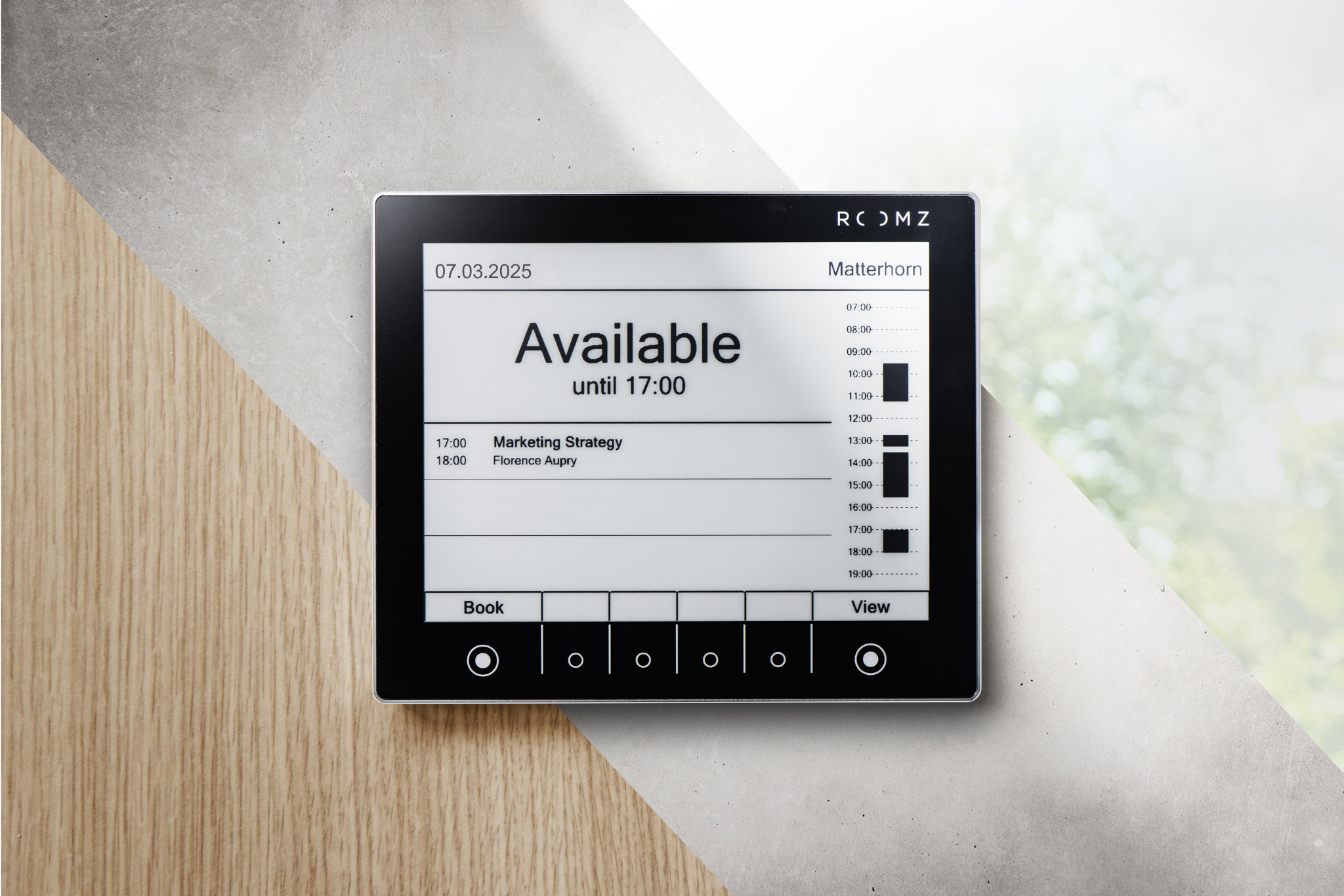
The display shows the room occupancy status and allows employees to make an instant booking directly outside the meeting room. As part of a meeting room digital signage solution, digital door signs improve the workplace experience by making room availability visible at a glance, as demonstrated by the ROOMZ Display.
Learn more about ROOMZ Display → - Educational institutions
Schools, universities, and campuses can replace printed timetables with digital door signs that are always up to date. The display automatically shows class schedules, room changes, and reservations. Information is synchronized with the timetable management software or room booking system, as demonstrated by the ROOMZ Education Solution.
Learn more about ROOMZ Education Solution → - Public sector, councils, and healthcare
Room assignments, consultations, and meetings are displayed in real time on the room booking display, helping visitors find the right location while improving day-to-day coordination for staff.
- Meeting rooms in the workplace
-
Key benefits of digital room signs
-
-
- Always up-to-date information
Any change made to the calendar or timetable is reflected on the display instantly. There is no need to print, replace, or check paper signs, and users no longer arrive at a meeting room with outdated information. - Better space utilization
In many organizations, meeting rooms are occupied less than 40% of the time on average. A room booking display makes available time slots visible at a glance and, depending on the solution, allows users to make an instant booking directly outside the room. - Simplified management and reduced administrative workload
All displays are managed from a centralized portal, from room assignments and display layouts to automatic firmware updates. Centralized management significantly reduces the repetitive administrative work associated with paper signs and traditional room signage. - A more professional workplace
Consistent, elegantly designed displays enhance corridors, reception areas, and meeting spaces. They provide clear, modern signage for both visitors and employees while reinforcing a professional workplace environment. - A more sustainable solution
There is no need for paper signs or laminated notices anymore. Thanks to E Ink® technology, room booking displays consume very little power. We will take a closer look at the different display technologies later in this guide.
- Always up-to-date information
-
How digital door signs work?
|
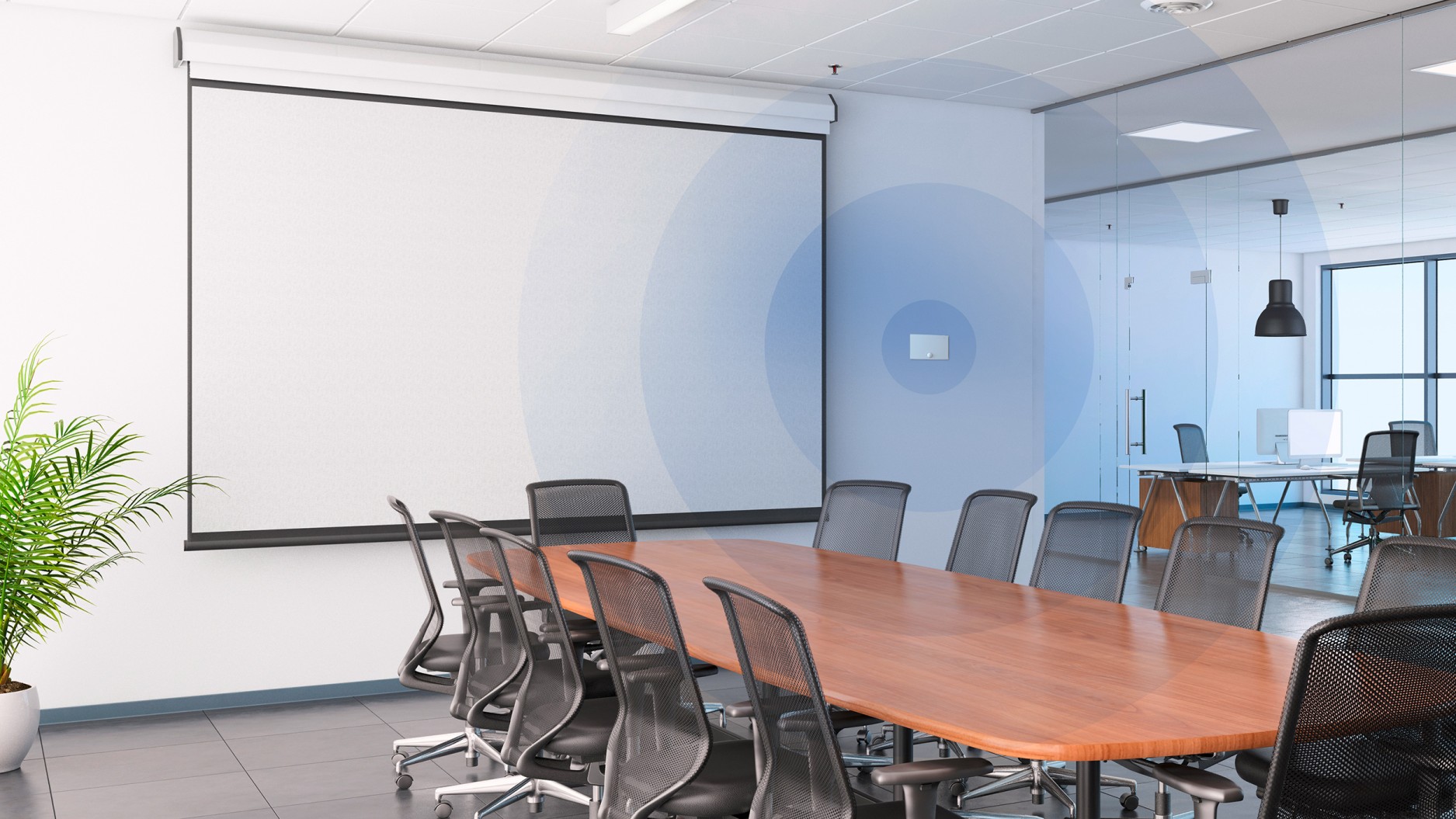
The ROOMZ Occupancy Sensor detects actual meeting room occupancy and automatically releases reservations for rooms that remain empty. |
E-Ink® vs. LCD: which technology is right for you?
| Criteria | Wireless E Ink® digital door sign | Wired TFT LCD panel |
|---|---|---|
| Installation | Mounts in minutes on glass, wood, or walls without cables or drilling | Requires power and network cabling or PoE, often involving electrical work and drilling |
| Power supply | Battery powered, up to 4 years of battery life with the ROOMZ Display | Continuous power via electrical wiring or a PoE switch |
| Power consumption | Minimal, E Ink® only consumes power when the display content changes | Continuous power consumption, significantly higher over time |
| Readability | Nearly 180° viewing angle with a paper-like display | Typically limited to a 90° to 120° viewing angle |
| Scalability | Add new rooms, floors, or buildings in minutes | Every expansion requires additional cabling |
| Maintenance | No operating system and automatic firmware updates | Operating system requiring regular updates and security patches |
| Security | No operating system, no cables, enterprise-grade secure Wi-Fi connection, and no personal data stored on the device | Operating system with potential security vulnerabilities, cabling as a possible attack vector, and data stored locally on the device |
| The environmental impact is just as compelling. Wired displays consume up to 10,000 times more energy than battery-powered E Ink® displays. Over an eight-year period, 100 wireless room booking displays can reduce CO₂ emissions by approximately 14 tons. The ROOMZ Display is designed to last more than 10 years, while the typical lifespan of a wired TFT LCD display operating 24/7 ranges from 3 to 7 years, depending on its quality. |
Installation: cable-free digital room signage
|
E Ink® displays, such as the ROOMZ Display, mount quickly and cleanly to smooth surfaces using an adhesive mounting system. |
What to look for when choosing digital door signs?
- Integration with the existing collaboration tools
Does the solution support your existing calendars and room booking platforms, such as Outlook, Exchange, Microsoft 365, Google Workspace, Microsoft Teams, or industry-specific software such as school management systems (e.g. Untis)? - Installation and scalability
How quickly can a room be equipped, and how easy is it to expand the deployment? Wireless systems scale across multiple rooms, floors, and locations without requiring an electrician. - Security and data protection
Look for encrypted communication (HTTPS/TLS), privacy-conscious data display, and an ISO 27001-certified provider. The processing of personal data should comply with GDPR requirements. The ROOMZ Display does not store or process personal data locally and has no operating system, making it highly resistant to malware installation. - Total cost of ownership (TCO)
Evaluate the solution over its entire lifespan, not just the purchase price. Consider hardware, software licenses, cabling, PoE switches, electricity, and maintenance. Also factor in installation and cabling costs, typically around €500 to €1,000 per cable, as well as the cost of replacing the device at the end of its service life. - Design and materials
Digital door signs help shape the first impression of corridors, reception areas, and meeting spaces. Real glass and aluminum create a more premium look than plastic, while a matte E Ink® surface eliminates glare and resists fingerprints. - Expandability
The greatest value comes from combining digital door signs with occupancy sensors to eliminate no-shows and analytics tools that measure how meeting rooms are actually used. Solutions such as ROOMZ Advanced Analytics provide the insights needed to make informed workplace and space planning decisions.
Learn more about ROOMZ Advanced Analytics →
Before rolling out digital door signs across your organization, it is worth starting with a pilot deployment in just a few rooms. This gives IT and Facility Management teams the opportunity to validate Wi-Fi coverage, calendar integration, installation, display layouts, and user adoption in a real-world environment.
A pilot project also reduces the risks associated with larger deployments across multiple floors or locations, while helping you identify the features that deliver the most value, whether that is instant booking at the display, occupancy sensing, workplace analytics, or dedicated views for classrooms and lecture halls.
|
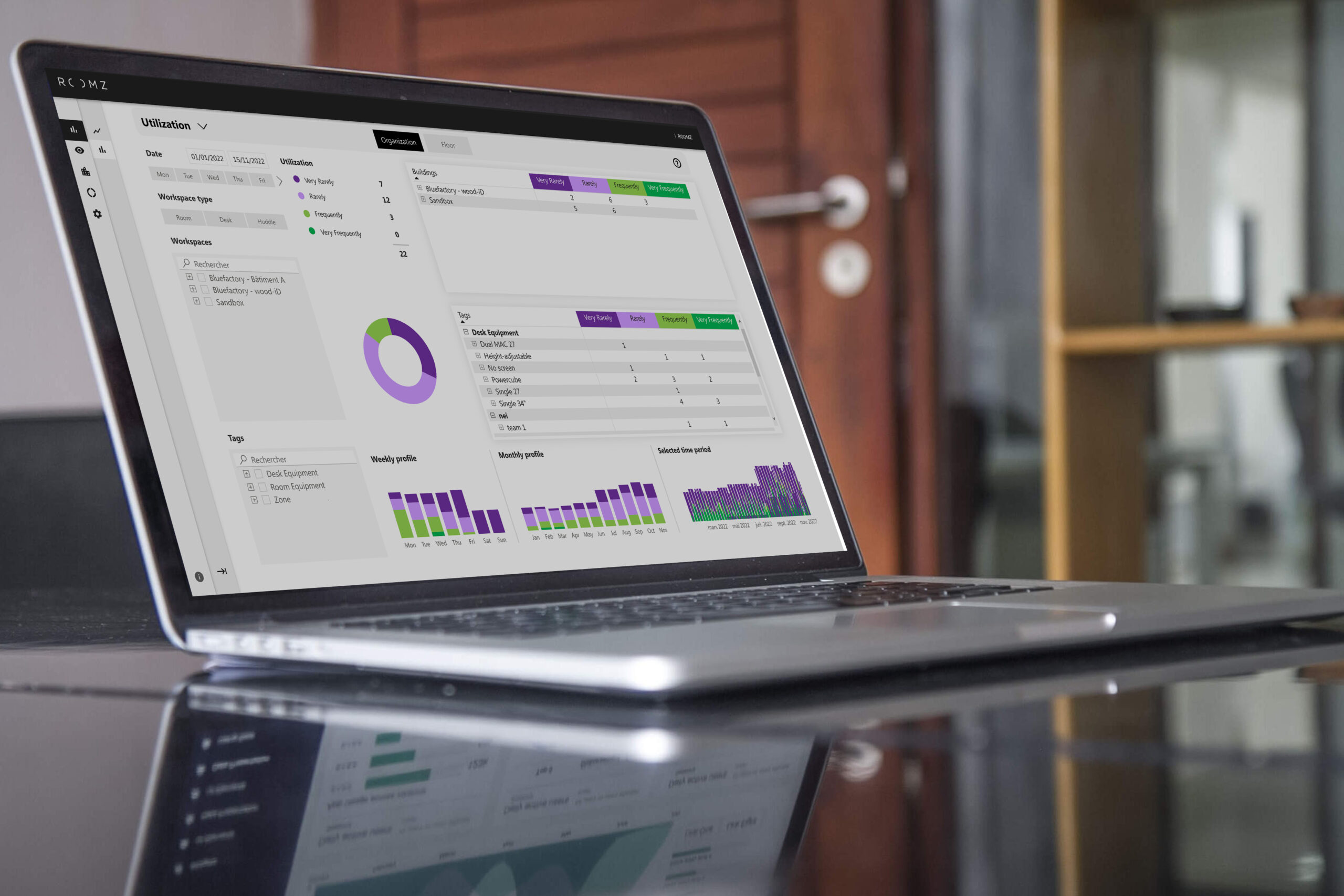
ROOMZ Advanced Analytics provides detailed insights into how meeting rooms are actually used, helping organizations make data-driven decisions to optimize their workplace strategy. |
Real-world examples: ETH Zurich, Cantonal School of Olten, and BOBST
Discover these projects, along with many more success stories from organizations such as ABB, Lonza and UNESCO, in the ROOMZ case studies.
Frequently asked questions about digital door signs
How much do digital door signs cost? The total cost includes hardware, software licenses, installation, and ongoing operation. Wireless E Ink® digital door signs eliminate the need for cabling, PoE infrastructure, and continuous power. Instead of comparing purchase prices alone, evaluate the total cost of ownership over the product’s lifespan. For E Ink® displays such as the ROOMZ Display, that is more than 10 years.
|
How are digital door signs powered? Wired LCD displays require continuous power through electrical wiring or Power over Ethernet (PoE). Wireless E Ink® digital door signs are battery powered. The ROOMZ Display typically delivers around 4 years of battery life, because E Ink® only consumes power when the displayed content changes.
|
Which systems can digital door signs integrate with? Most solutions synchronize with Microsoft Outlook, Exchange, Microsoft 365, Google Workspace, and Microsoft Teams. ROOMZ supports more than 20 room booking systems and also integrates with specialized software. At the Cantonal School of Olten, for example, ROOMZ is connected to the school’s timetable management software.
|
Can digital door signs be installed without cabling? Yes. Wireless E Ink® displays can be installed without drilling or cabling on glass, metal, or wood. With an optional mounting bracket, they can also be installed on masonry walls, making them ideal for historic buildings, leased offices, and other environments where electrical work is difficult or not permitted.
|
Are digital door signs GDPR compliant? Yes, provided the solution is designed with privacy in mind. The ROOMZ Display does not store personal information locally, all communication is encrypted using HTTPS/TLS, and ROOMZ is ISO 27001 certified and fully GDPR compliant.
|
Conclusion: it is time to replace paper signs outside meeting rooms
|
ROOMZ Experience Box
Experience ROOMZ in your workplaceInstall your first ROOMZ Display in less than an hour, with no cabling required. Discover how easy it is to deploy and manage a modern room booking display solution. |
| Author & Technical review |
|---|

Nadia ObeidaAuthor Creates and curates ROOMZ content focused on room booking, workplace experience, and digital workplace solutions. Nadia Obeida is Marketing Manager at ROOMZ. For this guide, she translated the needs of IT, Facility Management, and Office Management teams into a practical decision-making resource. She was also responsible for the article’s SEO/GEO strategy and editorial structure. |

Roger MeierCo-author & technical reviewer Contributes product expertise and real-world experience gained from ROOMZ customer projects. Roger Meier is the Founder and CEO of ROOMZ SA. He reviewed this guide from a technical perspective, ensuring the accuracy of its content on technology, integrations, scalability, and real-world deployment. |