Full calendars, empty rooms: in many offices, meeting rooms sit occupied less than 40 percent of the time on average, yet no one can find a free room on short notice. A meeting room display solves this problem right at the door. It shows in real time whether a room is free or occupied and lets employees book it on the spot. This guide explains which functions a meeting room display offers, whether a booking tablet works as an alternative, and what to look for when choosing a solution.
What is a meeting room display?
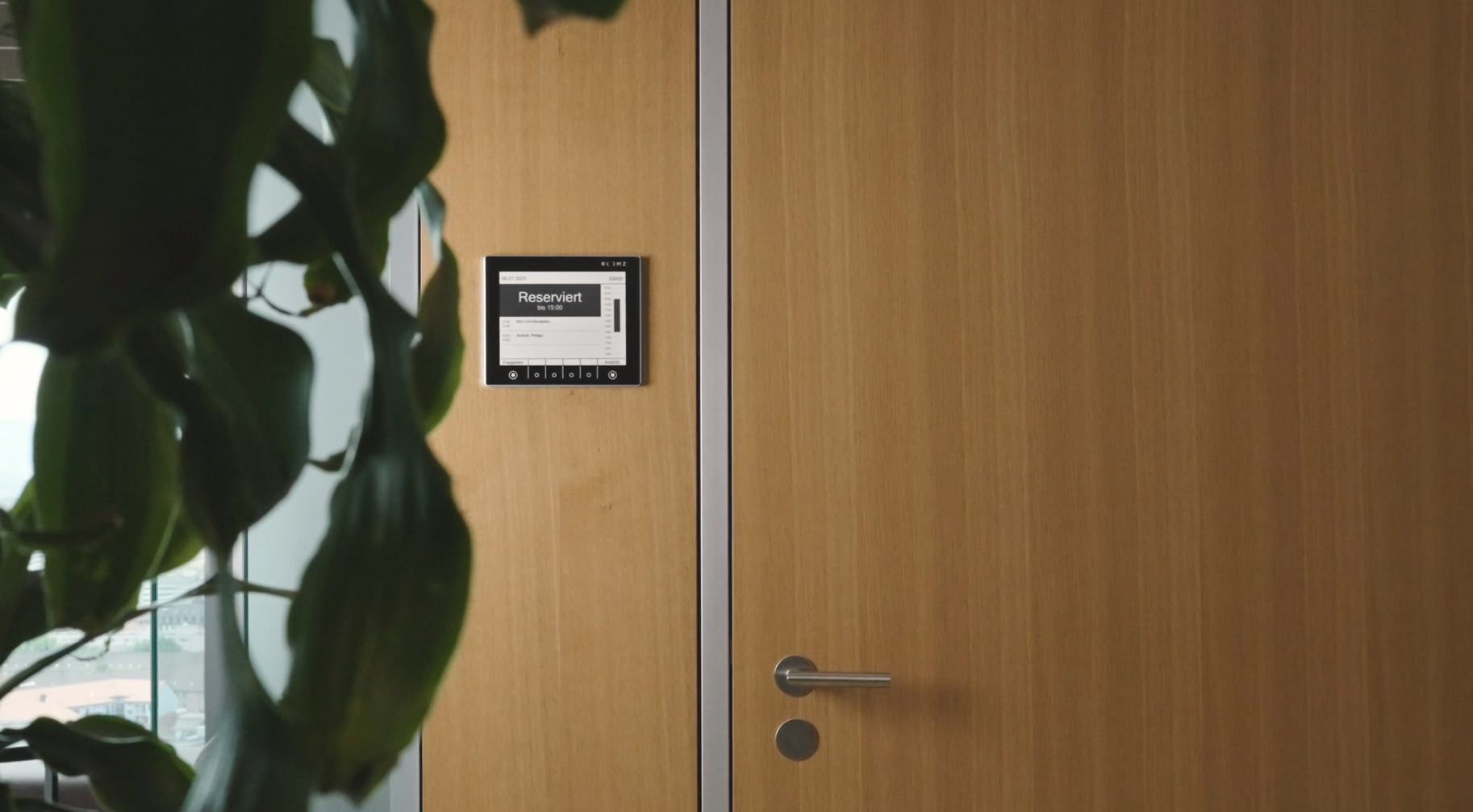
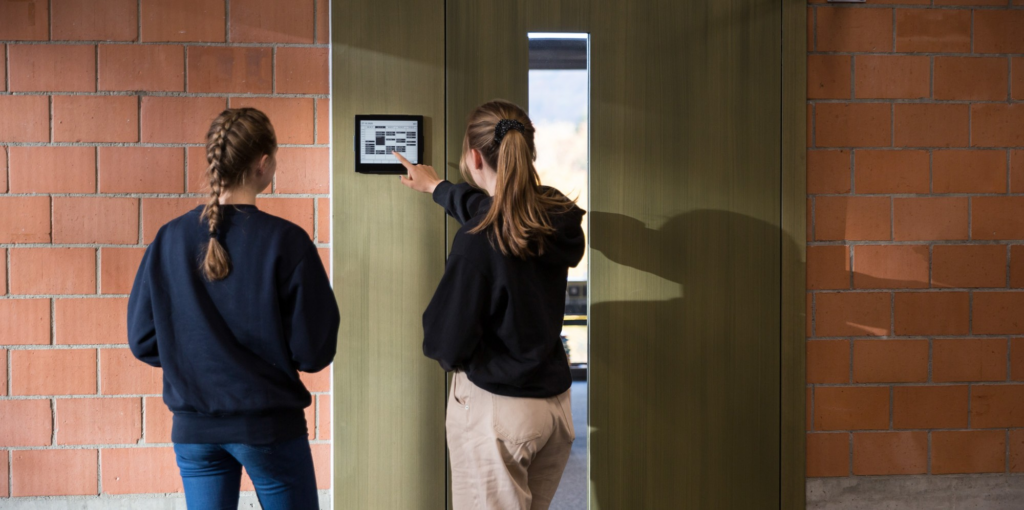
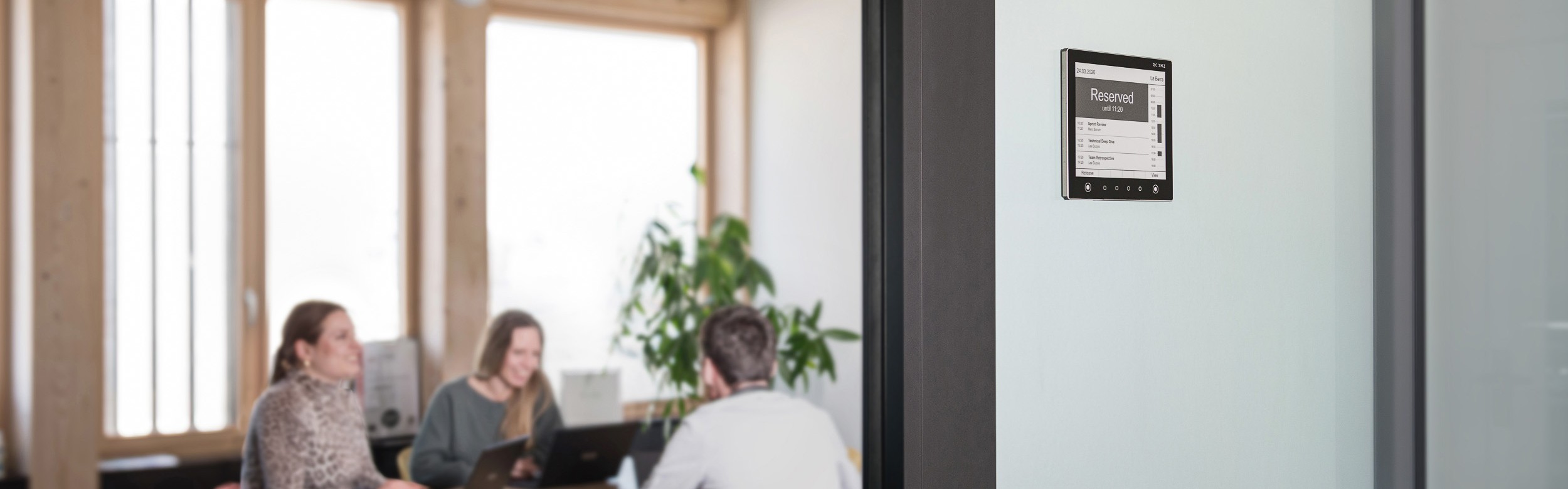
A meeting room display is a booking display mounted at the entrance of a room that shows booking status in real time. It shows the current occupancy status, upcoming bookings, and details such as the organizer, title, and duration of a meeting, all updated live. Employees can also book a room on the spot directly from the display (instant book) or release it again if a meeting ends early.
Depending on the provider and the market, different terms describe the same idea, for example meeting room panel, room booking display, conference room display, or meeting room availability display. All of these solutions pursue the same goal: making meeting room occupancy transparent and simplifying room booking. What they describe is always the same thing, the visible interface between employees and the company’s room booking system. The display for room booking pulls its data from the existing booking calendar, such as Microsoft Outlook or Google Calendar, and reflects every change without delay.
Core functions of a meeting room display in daily office life
A good meeting room display reduces search time, avoids friction in the hallways, prevents double bookings, and makes room usage transparent for everyone. Core functions include:
Occupancy status at a glance:
Whether a room is free or occupied is visible from outside the meeting room, without opening the door and interrupting an ongoing meeting.
Ad hoc booking on the spot:
Room is free? Press “book,” choose the duration, done. Instant booking makes free capacity usable for spontaneous meetings right away.
Releasing a room:
If a meeting ends early, participants release the room directly at the meeting room booking screen, which increases the utilization of meeting rooms.
Daily and weekly view:
Upcoming bookings are visible directly at the room, including the organizer and the time slot.
Information that stays current:
The room booking display reliably shows current and upcoming meetings at all times, with everything synchronized automatically and updated in real time.
Automatic synchronization:
Bookings made in the calendar appear immediately on the room booking display, and bookings made at the display update the calendar right away.
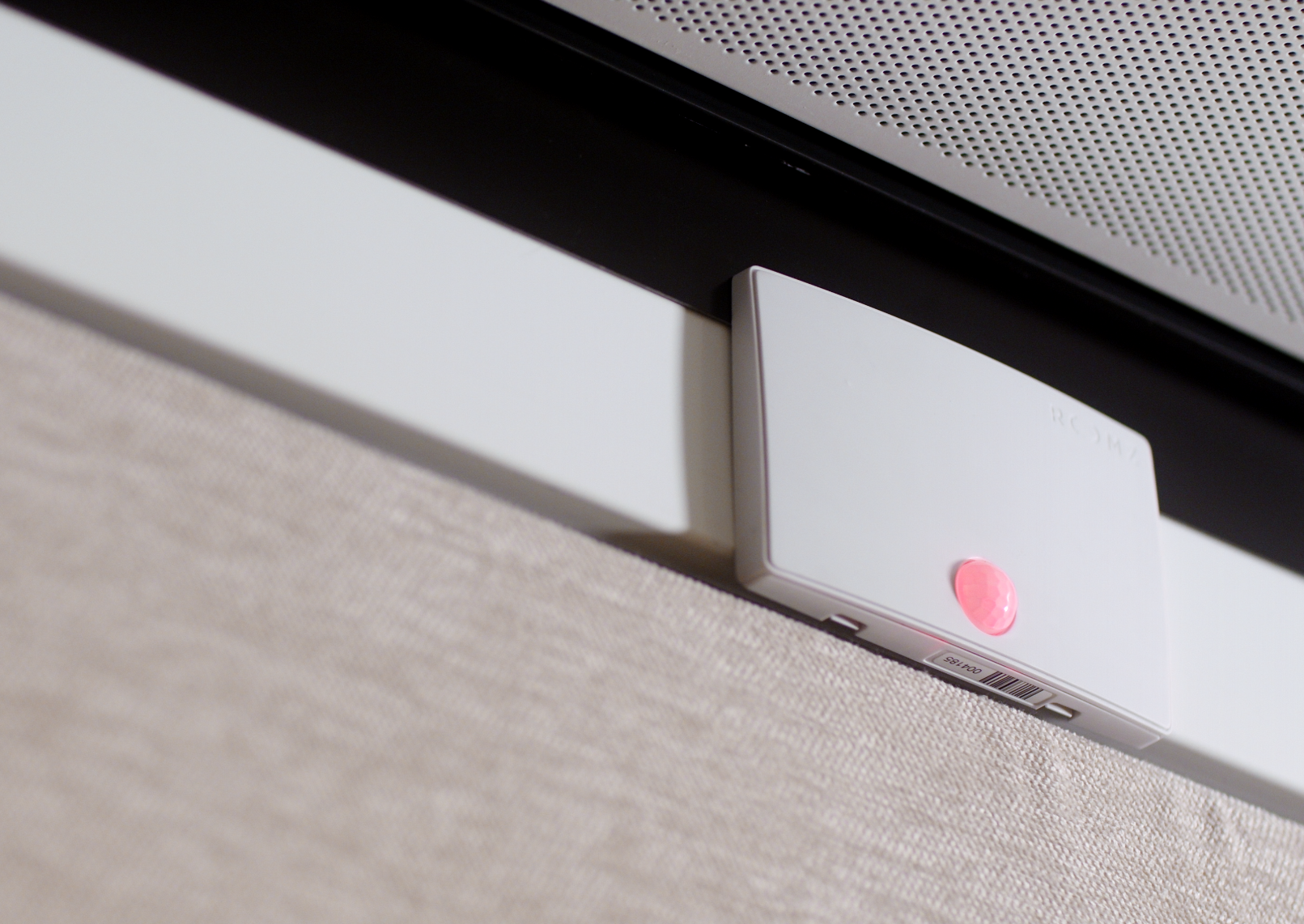
The ROOMZ Display adds one detail to these functions that makes a real difference in daily use. Combined with the ROOMZ Sensor, the system detects so-called ghost meetings, rooms that are booked but never actually used, and releases them automatically, with no manual check-in required.
The ROOMZ Occupancy Sensor measures actual room usage in real time and automatically releases unused reservations.
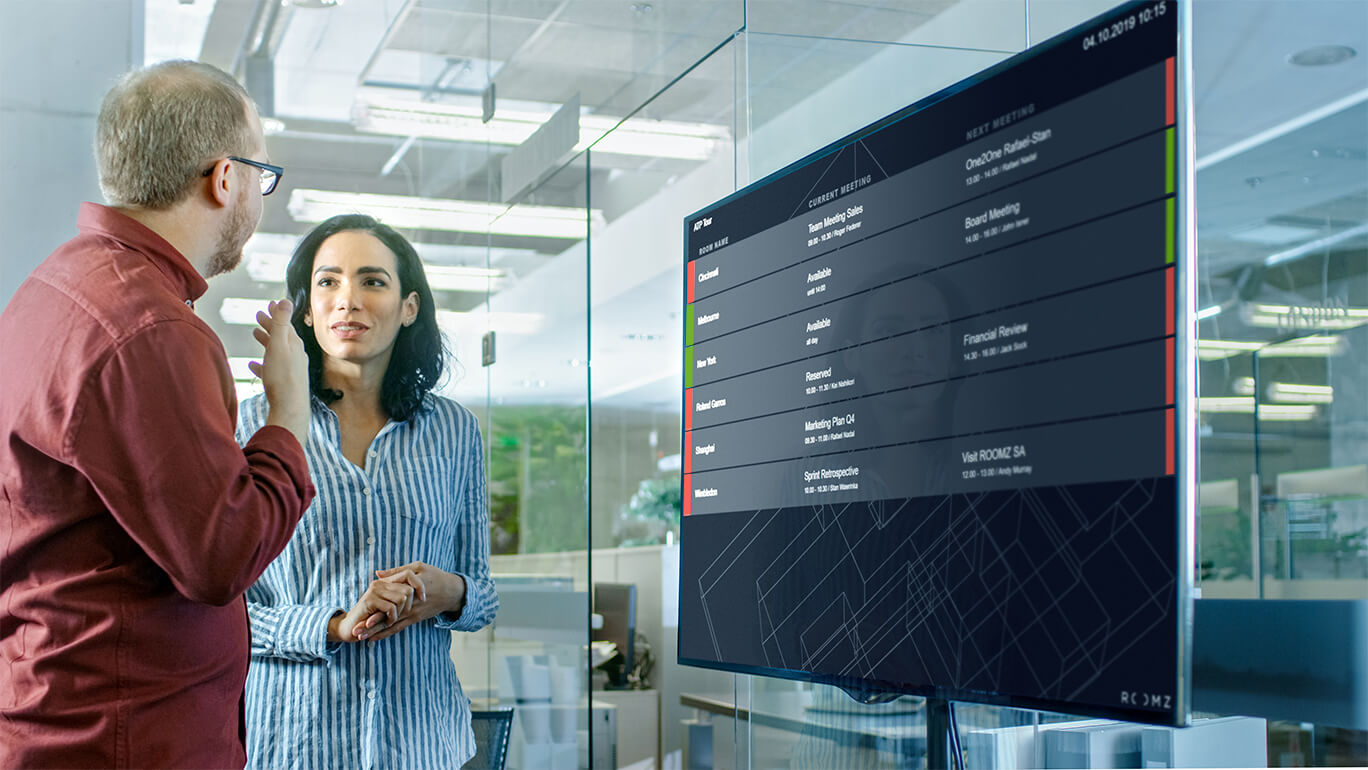
Companies that also want all bookings visible in one central place can display them as digital signage on a smart TV in the entrance area, using a flightboard view.
With the ROOMZ Flightboard, you keep track of room usage across all your meeting rooms in real time.
Benefits for employees, management, and facility management
A meeting room display pays off on three levels at once, which is exactly why the investment is easy to justify.
For employees:
The daily friction disappears: no guessing in front of closed doors, no interrupting meetings already underway, no detour through the calendar at their desk. Anyone who needs a room sees its availability directly on the meeting room panel and books it in two taps.
For management:
Adoption matters just as much as productivity. A system nobody needs explained is a system people actually use. Wireless solutions also cut installation costs significantly, since no power or network cables need to be run. At the same time, they offer maximum flexibility for future change: start with a single meeting room display and expand the solution at your own pace. When offices are redesigned, departments relocated, or entire sites moved, the displays can be repositioned within minutes and adapted to the new environment.
For facility management:
The leverage is greatest of all. Office space is the second-largest cost block in a company after salaries. At the same time, a study by workplace analyst Leesman shows that on Fridays only 21 percent of employees still come into the office, and that many companies could reduce their footprint by up to 40 percent without hurting productivity. Meeting room displays, together with occupancy sensors, provide the data to make such decisions based on actual usage rather than gut feeling, for example by closing entire floors on certain weekdays or consolidating teams and departments onto fewer floors.
In short: without an operating system, a major share of classic IT maintenance simply disappears.
What security requirements does the display meet?
A display with no operating system, no cables, and an enterprise-grade secured Wi-Fi connection stores no personal data on the device itself. An LCD panel, by contrast, runs an operating system with potential vulnerabilities, has cables that can serve as attack points, and stores data on the device.
In short: for companies with high IT security requirements, a solution without an operating system and without cables, such as the ROOMZ Display, meaningfully reduces the attack surface.
Booking tablet or dedicated display: what suits room booking best?
Many companies start with a booking tablet: an off-the-shelf iPad or Android device running a booking app, mounted at the door as a meeting room tablet. The unit price looks attractive, but in daily operation that advantage fades quickly.
Constant power required:
tablet batteries are not built for 24/7 continuous operation. In practice, that means a charging cable or an electrical installation at every door.
Operating system upkeep
iOS and Android devices need updates, app management, and usually mobile device management (MDM).
Theft and tamper protection:
a freely accessible tablet needs lockable mounts and a kiosk mode.
Readability and looks:
glossy LCD surfaces reflect light, show fingerprints, and stay lit at all times.
Integration: Microsoft Teams, Outlook, Google, and more.
A meeting room display is only ever as good as its connection to the existing booking system. That is why you should check integration first: ROOMZ synchronizes with Microsoft 365, Exchange, Google Workspace, and more than 20 booking systems in total. Anyone already running Microsoft Teams Rooms gains exactly the missing piece of information at the door with a conference room booking display: is this room free right now, and for how long?
Setup itself is not an IT project. Ninety percent of ROOMZ customers configure their first meeting room in under an hour. Bookings made in Outlook or Teams then appear automatically at the room, and the reverse holds true as well.
What to look for when choosing a meeting room display
Scalability:
it is worth looking ahead. What happens with a growing number of meeting rooms, or a move? A wired solution means new cabling work with every expansion, while a wireless solution can grow flexibly alongside the company.
Required security level:
is the data tied to resources such as rooms, employees, or meetings sensitive? If so, a solution without an operating system is recommended. Also look for encrypted transmission (HTTPS/TLS), a data-light display, and a provider certified to ISO 27001. Processing personal booking data must comply with GDPR requirements. The ROOMZ Display stores no information locally and runs no operating system, which meaningfully reduces the attack surface.
Integration with existing tools:
can the solution connect to collaboration tools already in use, such as Microsoft 365, Google Workspace, Microsoft Teams, or Exchange? Smooth integration is decisive for an easy rollout and strong adoption of the solution across the company.
Employee adoption:
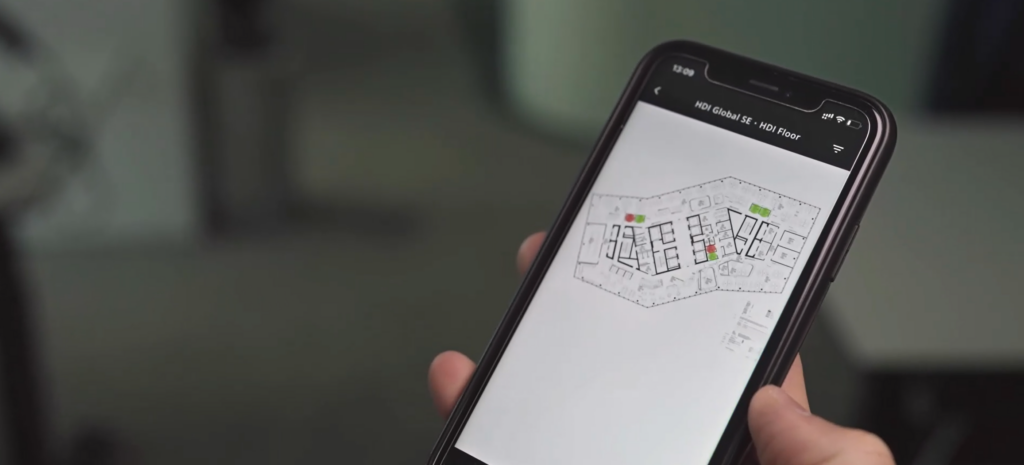
intuitive operation and real-time availability, including mobile access, largely determine whether a solution actually gets adopted in daily work.
Analysis of workspace usage:
companies that want to understand the actual usage of their office space, in order to build a sound space strategy, should choose a solution with workspace analytics. Data on room usage, peak times, no-show rates, and the most popular room types delivers valuable insight. A display alone only solves the problem at the door. Its full benefit only appears once it is combined with sensors and reporting: Advanced Analytics shows how rooms are actually used, the foundation for sound space decisions.
At the industrial group ABB, 62 displays across 44 meeting rooms at the Zurich headquarters replaced the old reservation system. Bartosz Patyna, headquarters information system project lead, put it simply: “ROOMZ is 100 percent the solution we were looking for. Wireless: that needs no further explanation. Simple instant booking: you walk up to the display, choose the time slot you want, press the button, done.”
At the pharmaceutical supplier Lonza also made a deliberate choice against cabling, opting instead for a system that grows alongside the company. More examples, from Pilatus to ETH Zurich to the University of Basel, are available in the ROOMZ case studies.
Conclusion: the right meeting room display makes your rooms more productive
A meeting room display ends the guessing game at the door, puts free capacity to use, and, together with sensors and analytics, provides the data foundation for better space decisions. What matters is integration, security, total cost of ownership, and scalability, not the unit price or whether a tablet might be cheaper in the short term.
The fastest way to see this for yourself is in your own office: with the ROOMZ Starter Kits, you can equip a first meeting room in under an hour, wireless, Swiss Made, and in use for 10 years at companies such as ETH Zurich, ABB, and Lonza.
Author & expert review
Nadia Obeida
Marketing Manager at ROOMZ
Author
Nadia translated the requirements of IT and facility teams in schools and universities into a practical decision-making resource and defined the SEO and GEO structure of this article.
Roger brings the product and field perspective from ROOMZ projects in schools and universities. He reviewed this article with a focus on technology, integration, scalability and practical relevance.
Yes. ROOMZ is compatible with Microsoft Teams and synchronizes with Microsoft 365, Exchange, Google Workspace, and more than 20 other booking systems. Bookings made in Outlook or Teams appear automatically on the display.
Combined with a room occupancy sensor, the system detects whether a booked room is actually being used. If no one shows up, it releases the room automatically, with no manual check-in required.
Yes, provided the solution is data-light by design. The ROOMZ Display stores no information locally, transmission is encrypted via HTTPS/TLS, and ROOMZ is certified to ISO 27001 and fully GDPR compliant.
Yes. Wireless displays can be mounted on glass, wood, or masonry without drilling and without running cables, even in listed buildings or leased spaces.
Move from theory to practice and test ROOMZ in real conditions. In just a few minutes, you will discover a simpler, smoother and more modern way of managing spaces.